1. Blog
  2. Does Outrank Actually Work? 90 Sites Analyzed
Felix Vemmer, Author

Felix Vemmer

Founder

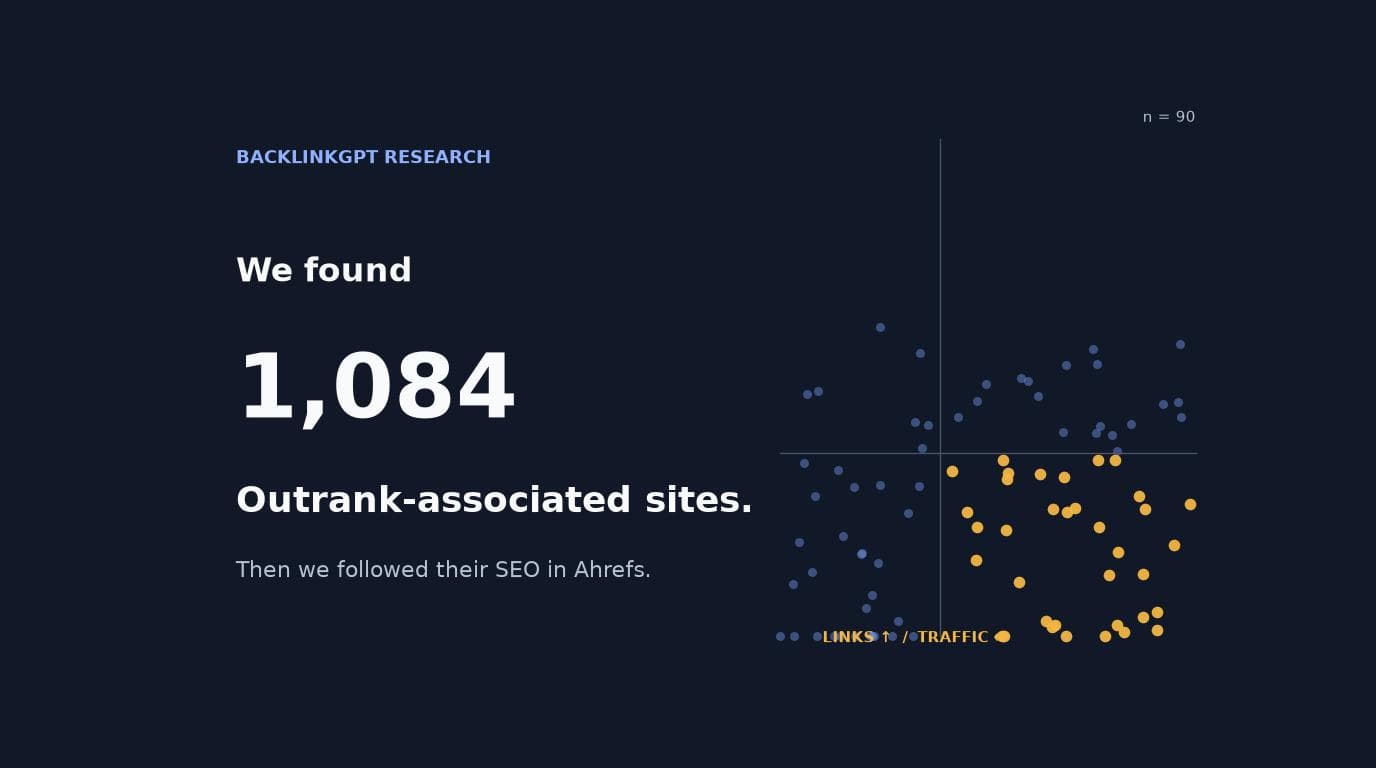
We Found 1,084 Outrank-Associated Sites. Did the AI Posts Actually Rank?

We traced Outrank through its CDN and backlink network, sampled 90 mature sites, and checked the attributable posts—not just the domains—in Ahrefs.

Outrank sells one of the cleanest promises in SEO: connect a site, let the software research keywords, publish 30 AI articles a month, and earn backlinks from other users automatically. Its own site calls this organic growth “on auto-pilot” and says the backlink exchange can start improving Domain Rating within weeks.

That is a testable promise.

We traced public Outrank signals across the web, found 1,084 associated properties, drew a seeded sample of 90 mature sites, and pulled their Ahrefs histories. Then we caught the most important analytical trap: a domain growing after it starts using Outrank does not mean Outrank caused the growth.

So we ran the stricter test too. For every sampled site, we measured one specific post that was publicly attributable to Outrank.

The short version: Outrank can produce pages that rank. Most of the verified pages in our sample did not produce meaningful traffic. Meanwhile, backlinks and DR often grew faster than organic results.

Disclosure

I run BacklinkGPT, a link-building product. Outrank is adjacent to—and in parts competes with—what we build. That conflict is why this post separates direct page performance from domain-wide correlation, names the thresholds, and includes unfavorable as well as favorable cases.

August 2026 update: what the $54,000 marketplace claim actually assumes

On August 25, Outrank opened a backlink marketplace for publishers. The pitch is simple: sites with DR 40+, 100+ monthly organic clicks in Google Search Console, and a connected blog can publish AI-written articles containing one advertiser link. The publisher receives $1 per DR point per article.

The launch post on X quickly received a Community Note about Google’s paid-link rules. Critical quote-posts argued that publishers would be trading long-term search equity for short-term cash. Rather than score the discourse, we turned those objections into three testable questions: Is $50,000 a plausible expectation or only a ceiling? How many known Outrank sites could even reach that ceiling? And what SEO asset would those publishers be putting at risk?

The viral example says a DR 50 site publishing three articles a day can make $4,500 a month or $54,000 a year. The arithmetic is correct. The interpretation needs more work.

Paid articles at the cap
1,080/year
90 placements every month for 12 months
DR 50 fill needed for $50k
92.6%
83.3 of the 90 monthly slots
Seller-requirement proxy
13.4%
Population-weighted July estimate; 95% CI 8.1–19.1%
$50k-ceiling proxy
7.3%
Required both the seller proxy and DR 47+; 95% CI 3.3–11.9%
Candidates already declining
6/9
Ahrefs traffic in the month before launch

The headline is a ceiling, not expected revenue

Outrank caps publishers at 90 placements per month and explicitly says that volume depends on advertiser demand in the site’s niche and language. There is no guaranteed minimum.

For a DR 50 site, the sensitivity looks like this:

Marketplace fill ratePlacements/monthAnnual revenue
25%22.5$13,500
50%45.0$27,000
75%67.5$40,500
92.6%83.3$50,000
100%90.0$54,000

At the 90-placement cap, DR 47 is the first integer DR with a theoretical $50,000 annual ceiling. But even a DR 50 site needs 83.3 placements every month—92.6% utilization—to clear $50,000. That is a marketplace-liquidity assumption, not merely a publishing setting.

How much of the earlier Outrank cohort could qualify?

We reused the same seeded 90-site sample from this study. In the July Ahrefs snapshot, 16 of 90 sites had DR 40+ and at least 100 estimated monthly organic visits. Nine of 90 also had DR 47+, giving them a theoretical $50,000 ceiling at full marketplace utilization.

Because the original sample deliberately contains 30 sites from each traffic stratum, we reweighted those counts to the 726-site eligible population. The resulting estimates are:

  • 13.4% met the Ahrefs-based seller proxy (95% stratified-bootstrap interval: 8.1–19.1%).
  • 7.3% met the proxy and had the DR needed for a $50,000 ceiling (3.3–11.9%).

These are opportunity proxies, not enrollment or revenue forecasts. Outrank checks first-party GSC clicks, not Ahrefs-modeled traffic, and also requires three months of GSC history plus a supported publishing integration. We cannot observe those requirements.

The SEO asset being monetized

On August 26, we refreshed all 16 July seller-proxy sites in logged-in Ahrefs Site Explorer through Chrome. Fourteen still met the Ahrefs proxy. Nine had both DR 47+ and at least 100 modeled monthly visits, preserving a theoretical $50,000 ceiling.

Their immediate pre-launch baseline was mixed:

DomainCurrent DRAhrefs trafficOne-month changeAnnual maximum
magicui.design6812,000+3.0%$73,440
gethostai.com62361+2.6%$66,960
myaifrontdesk.com627,600−60.2%$66,960
gohappybeauty.com57659−1.6%$61,560
batchdata.io556,100+7.3%$59,400
blog.parakeet-ai.com531,700−34.8%$57,240
avenacloud.com525,100−1.9%$56,160
showdigs.com491,200−11.8%$52,920
taggd.in4953,700−43.7%$52,920

Six of the nine were already losing modeled organic traffic in the month before the marketplace opened; the median change was −1.9%. Across all 16 July proxy qualifiers, 10 were down and six were up.

This is not evidence that the marketplace hurt them. It had only just launched. It is a frozen baseline showing what is economically at stake: Outrank is asking publishers to monetize search authority and traffic they have already built, including sites whose organic performance is currently fragile.

The policy question cannot be answered from the sales page

Google’s link-spam policy explicitly includes exchanging money for links or posts containing links when the purpose is ranking manipulation. Paid links are allowed when they are qualified with rel="sponsored" or rel="nofollow", as Google explains in its outbound-link guidance.

Outrank’s visible publisher page describes a complete article with one advertiser link and says selling links is “never zero-risk.” As of August 26, that page did not state whether live placements use sponsored, nofollow, or neither. That absence is not proof of a violation. The actual HTML of live placements determines the answer.

The right follow-up date is November 23, 2026, 90 days after launch and the same duration Outrank says it monitors each placement. At that point the useful study is no longer theoretical: measure realized fill rates and payouts, enumerate live placement URLs, inspect link attributes and topical fit, track removals and refunds, and compare seller sites with matched non-sellers on GSC clicks, rankings, and conversions.

The result in five numbers

Properties identified
1,084
Public Outrank attribution, CDN, or network signals
Verified posts sampled
90
One attributable Outrank page per mature site
Posts with any traffic
27/90
30.0% at months +4 to +6
Posts with 10+ visits
8/90
8.9% averaged ≥10 estimated visits/month
Links up, traffic not up
20.1%
Population-weighted domain-level estimate

The page-level number is the one to remember. Six months after the first observable Outrank signal, 27 of the 90 verified posts had any Ahrefs-estimated organic traffic. Eight averaged at least 10 monthly visits. In the current snapshot, five contributed at least 10% of their site’s estimated organic traffic.

That is not zero. It is also far from “30 articles a month on autopilot” turning every site into a search engine.

How we found the network

Outrank leaves several public fingerprints. Some articles carry explicit attribution. Many load images from cdn.outrank.so. The backlink exchange also creates a visible graph of participating sites.

We combined:

  • Ahrefs backlinks to Outrank and its CDN;
  • exact-match Google searches for cdn.outrank.so, excluding Outrank’s own domain;
  • explicit “created using Outrank” attribution;
  • CDN account and article identifiers embedded in public asset URLs.

That produced 1,084 distinct web properties. We call them Outrank-associated properties, not customers. A public CDN asset or attribution is strong evidence that the product was used; it does not prove the owner is currently paying, still active, or opted into every feature.

Of those 1,084, 726 had high-confidence product-use evidence and at least six months of follow-up. We divided them into three current-traffic bands—under 100, 100–999, and 1,000+ estimated monthly organic visits—and sampled 30 from each using the fixed seed 20260724.

The direct test: did the Outrank posts themselves rank?

For each of the 90 sites, we retained one publicly verifiable Outrank-attributed URL. We queried that exact page in Ahrefs, not the whole domain.

The primary window compares the post’s Ahrefs visibility in event months +4 through +6 after the first observable Outrank signal. Missing exact-URL history was treated as zero visibility. We also took a current snapshot to measure how much of the site’s traffic the page contributes today.

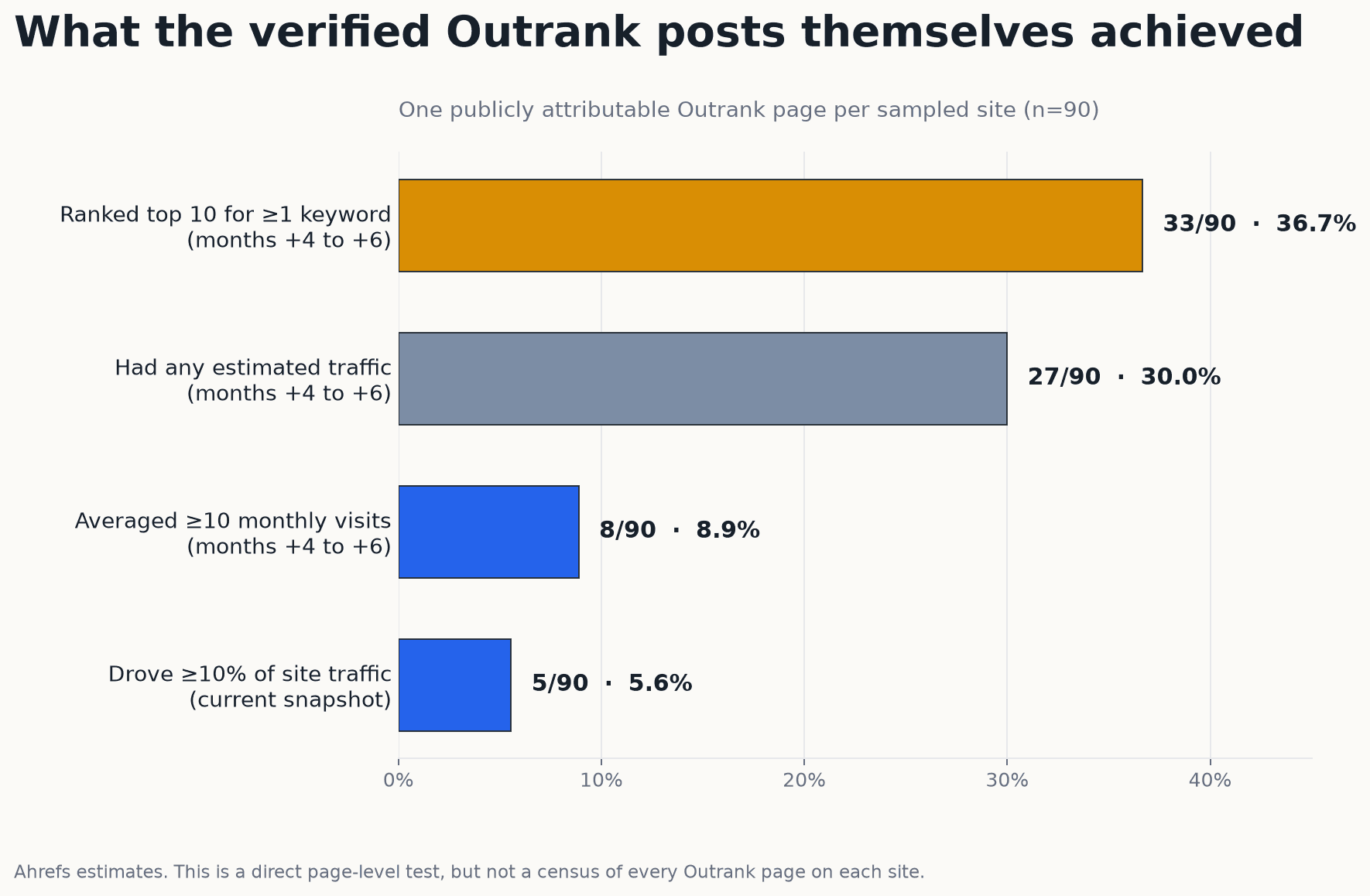
Direct page-level results for one publicly attributable Outrank post per sampled site.

The gap between “ranked” and “mattered” is striking:

  • 33/90 posts ranked in the top 10 for at least one keyword.
  • 27/90 had any estimated organic traffic.
  • 8/90 averaged at least 10 estimated visits per month.
  • 5/90 currently account for at least 10% of their site’s estimated organic traffic.

Among the 23 verified pages with current traffic, the median contribution was 1.7% of site traffic. In other words, the typical successful page in this particular test was a supporting asset, not the engine of the domain.

There are two opposite biases to keep in mind. Measuring only one known page per site understates Outrank’s total contribution when it produced many pages. But publicly discoverable pages may be easier to find precisely because they were indexed, which can make the per-page hit rate look better than the full unpublished or unindexed output. This is a direct test, not a complete content inventory.

Three posts tell the story better than an average

A real winner: Diamona Harnisch

The Outrank-attributed article about a German tenancy-law topic went from no observed pre-period visibility to an average 238 monthly visits and 70 top-10 keywords in months +4 to +6.

When we checked it directly in Ahrefs on July 24, it showed about 336 estimated monthly visits across 74 keywords, or 11.5% of the domain’s traffic. The page had zero referring domains in the report.

That last detail matters. This was not a story where hundreds of exchange links brute-forced a weak page upward. It is evidence that an Outrank-generated article can match search intent and win on its content, internal context, and host domain.

A useful contributor: Evolution Flight

The verified multi-rotor drone article averaged about 22 visits in the post window. In the current Ahrefs snapshot it had roughly 102 estimated monthly visits from 13 keywords, almost entirely non-branded and informational. It represented roughly one-third of the site’s estimated traffic and had two referring domains.

That is a good outcome for one article. It is also a much more useful success definition than “DR went up.”

A zero: SpartanSuppz

The attributable “best supplements for building muscle” post currently showed zero organic keywords, zero organic traffic, zero referring domains, and zero backlinks in the exact-URL Ahrefs report.

The domain-wide story was also negative in our event window: estimated traffic fell from 1,179 to 552 while referring domains increased by 30. The site now sits around 349 estimated monthly visits.

One page does not condemn a product. But this is exactly why publishing volume is not the same thing as creating search assets.

The broader domain study looks better—but proves less

We also ran a conventional before/after event study at the domain level. The pre-period is the mean of months −3 to −1. Months 0 to +3 are treated as adoption and ramp. The post-period is the mean of months +4 to +6.

A site counted as positive only when traffic rose materially and either top-10 keyword count or ranking-page count corroborated the move. The negative label uses the same rule in reverse. We reweighted the equal-strata sample to match the 726-site eligible population and bootstrapped the uncertainty intervals 5,000 times.

Whole-domain outcomes are useful context, but they cannot isolate Outrank from other SEO work.

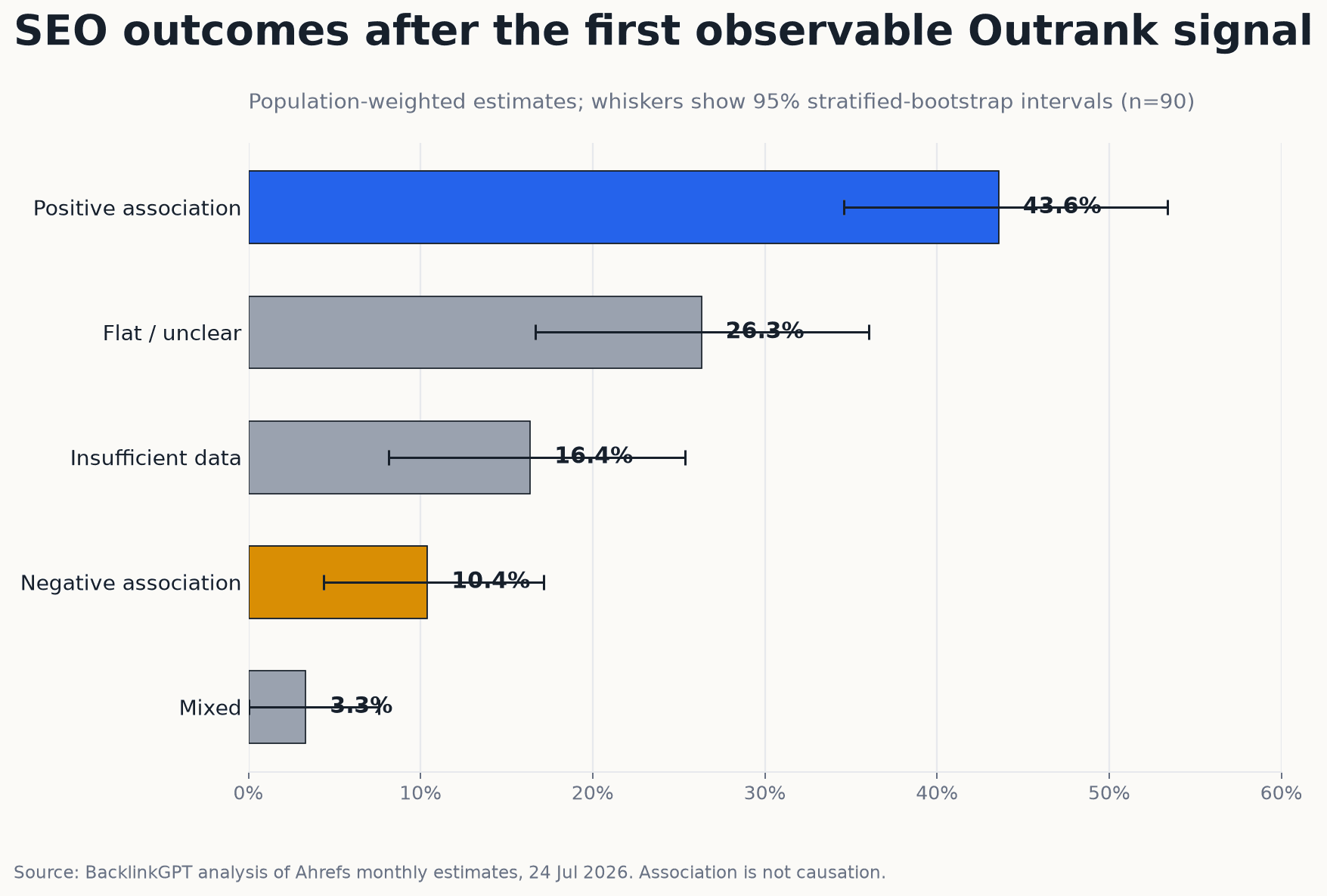
The population-weighted estimates were:

Domain-level outcomeEstimated share95% interval
Positive association43.6%34.6–53.4%
Flat or unclear26.3%16.7–36.0%
Insufficient baseline16.4%8.1–25.4%
Negative association10.4%4.4–17.1%
Mixed signals3.3%0–7.6%

That is a better result than the critical posts about AI “slop” might lead you to expect. Nearly half the eligible population showed a positive association.

It is not a causal win rate. Of the 41 positive cases with enough slope history, only 23—56%—accelerated versus their pre-signal growth trend. Some winners were already growing. Sites may also have launched products, earned press, changed technical SEO, or published content outside Outrank.

The large gap between 43.6% positive domains and 8.9% materially trafficked verified pages is precisely why the page-level test belongs first.

The backlink exchange often moves the metric it promises

Outrank describes its backlink exchange as an automatic network that places contextually relevant links in other users’ articles. The company foregrounds Domain Rating growth and says users often see measurable improvements within two to four weeks.

The mechanism frequently did create links. The business outcome was less dependable.

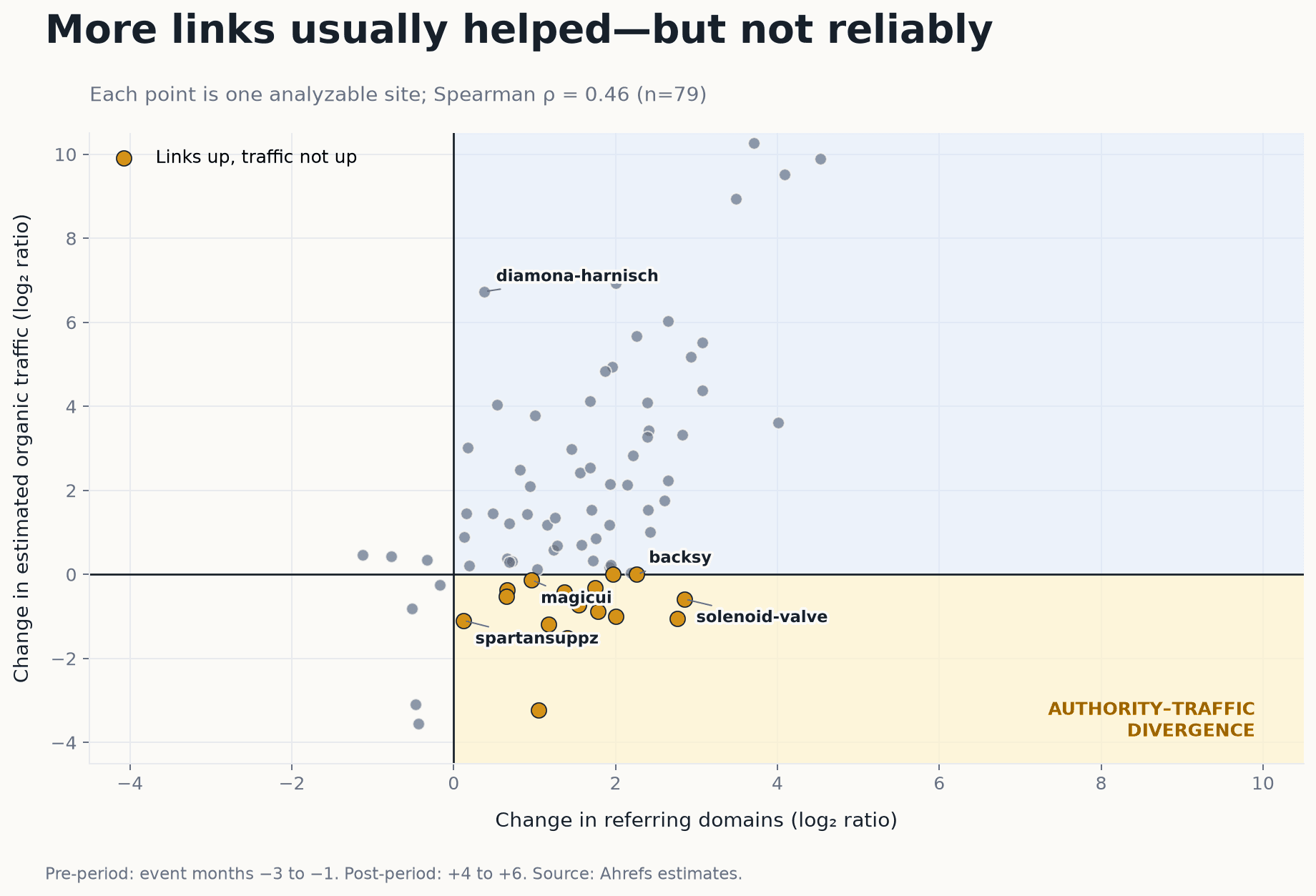
Referring-domain growth and traffic growth were related, but one in five sites landed in the links-up, traffic-not-up quadrant.

Across the 79 sites with complete before/after data, referring-domain growth and traffic growth had a moderate Spearman correlation of 0.46. More links were generally associated with more traffic.

But:

  • 20.1% of the eligible population was estimated to gain referring domains while traffic failed to rise.
  • 16.8% increased Ahrefs DR by at least one point while traffic failed to rise.

Magic UI is the cleanest illustration. In the event window it added roughly 939 referring domains and 10 DR points, while estimated traffic slipped from 10,579 to 9,666. By our July snapshot, traffic had recovered to about 12,800. That recovery is important: the earlier divergence was real, but it was not necessarily permanent harm.

Ahrefs itself warns against treating DR as a business outcome. DR measures the relative strength of a backlink profile, and there is no evidence that search engines use Ahrefs DR as a ranking factor.

This study did not detect Google penalties, and it cannot determine whether any traffic decline was caused by link quality. It shows something narrower and more defensible: authority metrics can move without the corresponding traffic outcome.

Is the model sustainable?

Google does not prohibit AI-assisted content. Its policy focuses on purpose and value. The risk begins when pages are generated at scale primarily to manipulate rankings without adding value. Google’s spam policies also list excessive link exchanges and automated link-creation services as examples of link spam.

That does not prove Outrank’s exchange violates policy. Context, scale, qualification, and how links are implemented all matter. It does mean “automatic reciprocal network” deserves more scrutiny than “DR increased.”

The sustainable version of this model needs four controls:

  • judge every page on intent match and originality before publishing;
  • measure URL-level impressions, clicks, and conversions in Search Console;
  • refresh or remove pages that remain invisible after a defined window;
  • accept links for editorial relevance, not to satisfy a network credit loop.

The mistake is not automation. The mistake is allowing the proxy—articles published, links placed, DR gained—to replace the outcome.

Our verdict on Outrank

Outrank is not a simple “works” or “doesn’t work.”

It produced genuine winners in this sample. One verified article drives hundreds of estimated visits; another supplies roughly a third of its site’s search traffic. At the domain level, positive associations clearly outnumbered negative ones.

But the median experience was much less dramatic than the autopilot framing suggests. Only 8 of 90 verified pages averaged 10 or more visits in the post window. Only 5 currently make up at least 10% of site traffic. And about one in five sites displayed the exact failure mode critics worry about: more referring domains without more traffic.

My honest description is:

Outrank is a high-variance content engine attached to a backlink system that is better at moving authority metrics than guaranteeing search demand.

That can be useful for a new site with low publishing capacity and a tolerance for review, pruning, and uneven outcomes. It is a riskier proposition for an established brand that interprets “autopilot” literally.

What we are taking into BacklinkGPT

This study changed how I think about building any user-powered backlink network.

A network should not optimize for the number of exchanges or for DR. It should optimize for whether a real editor would add the link without the network existing. That means no forced reciprocity, no irrelevant matching, and no success dashboard that stops at “link acquired.”

BacklinkGPT’s bet is that autonomous discovery and outreach can scale while the placement decision remains contextual and auditable. If we build a network layer, the metrics that matter will be qualified referral traffic, ranking-page lift, and conversions—not credits circulated.

If you want to see the current product before that layer exists, BacklinkGPT finds relevant pages, contacts the people behind them, drafts personalized outreach, and keeps a human approval step before anything sends.

Methodology note

Ahrefs Organic Traffic is an estimate based on observed rankings, search volume, and modeled click-through rate—not first-party analytics. Ahrefs recommends using it comparatively and as a trend signal. The first observable Outrank signal is also not a verified subscription start date. There is no untreated control group. The original event-study results are associations as of July 24, 2026; the marketplace section is a pre-effect baseline refreshed on August 26, 2026.

On this page

August 2026 update: what the $54,000 marketplace claim actually assumesThe headline is a ceiling, not expected revenueHow much of the earlier Outrank cohort could qualify?The SEO asset being monetizedThe policy question cannot be answered from the sales pageThe result in five numbersHow we found the networkThe direct test: did the Outrank posts themselves rank?Three posts tell the story better than an averageA real winner: Diamona HarnischA useful contributor: Evolution FlightA zero: SpartanSuppzThe broader domain study looks better—but proves lessThe backlink exchange often moves the metric it promisesIs the model sustainable?Our verdict on OutrankWhat we are taking into BacklinkGPTMethodology note
Published on Jul 24, 2026 · Updated on Aug 26, 2026

Keep reading

We Pointed Our AI Link Building Agent at Our Own Startup. Here's Every Email.
Felix VemmerFelix Vemmer
·Jul 19, 2026

We Pointed Our AI Link Building Agent at Our Own Startup. Here's Every Email.

14 days of dogfooding: 499 pages judged, 35 emails sent, one DR 50 backlink closed in 3 days for $80 — every pitch, reply, and rejection documented.

Backlink Builder Guide: How to Build High-Quality Backlinks in 2026
Felix VemmerFelix Vemmer
·Mar 5, 2026

Backlink Builder Guide: How to Build High-Quality Backlinks in 2026

Learn how to build high-quality backlinks in 2026 with 11 proven, data-backed strategies.

BacklinkGPT LogoBacklinkGPT

Your AI agent for backlinks. It hunts, drafts, and waits for your go.

Content

  • The agent
  • How it works
  • Docs
  • Affiliate Program

Socials

  • Twitter
  • YouTube
  • Instagram
  • TikTok
© 2026 FMD Labs GmbH
Disclaimer · Privacy · Terms
BacklinkGPT LogoBacklinkGPT
  • Agent
  • How it works
  • Pricing
App
  • BlogLink-building playbooks, teardowns & product news
  • DocsSet up your agent and learn how it works
  • CompareHow BacklinkGPT stacks up against alternatives
  • Free toolsFree authority checker & backlink opportunity scan
Home
  • Agent
  • How it works
  • Pricing
  • FAQ
Start 7-day trial
We Found 1,084 Outrank-Associated Sites. Did the AI Posts Actually Rank?
Population-weighted domain SEO outcomes after the first observable Outrank signal
Bar chart showing the direct Ahrefs performance of 90 verified Outrank-attributed posts
Scatter plot comparing referring-domain growth with estimated organic-traffic growth across Outrank-associated sites