

At a glance
BacklinkGPT vs LinkDR
LinkDR lets you order individual backlinks by DR and traffic. BacklinkGPT runs an ongoing outreach pipeline under your brand — and asks for your approval before anything sends.
- You want an agent to keep your backlink pipeline moving instead of buying links one by one.
- You want to see why each prospect was chosen and approve every email or LinkedIn message.
- You want the outreach relationships to stay in your own inboxes and pipeline.
- You want to buy a specific number of links at a chosen DR and traffic level.
- You would rather hand off publisher matching and placement content.
- You are comfortable paying extra for listicles, reviews, or approving each publisher yourself.
TL;DR
The short version. Use the sections below if you need details.
- This is the real choice: run an owned outreach pipeline or buy links one at a time.
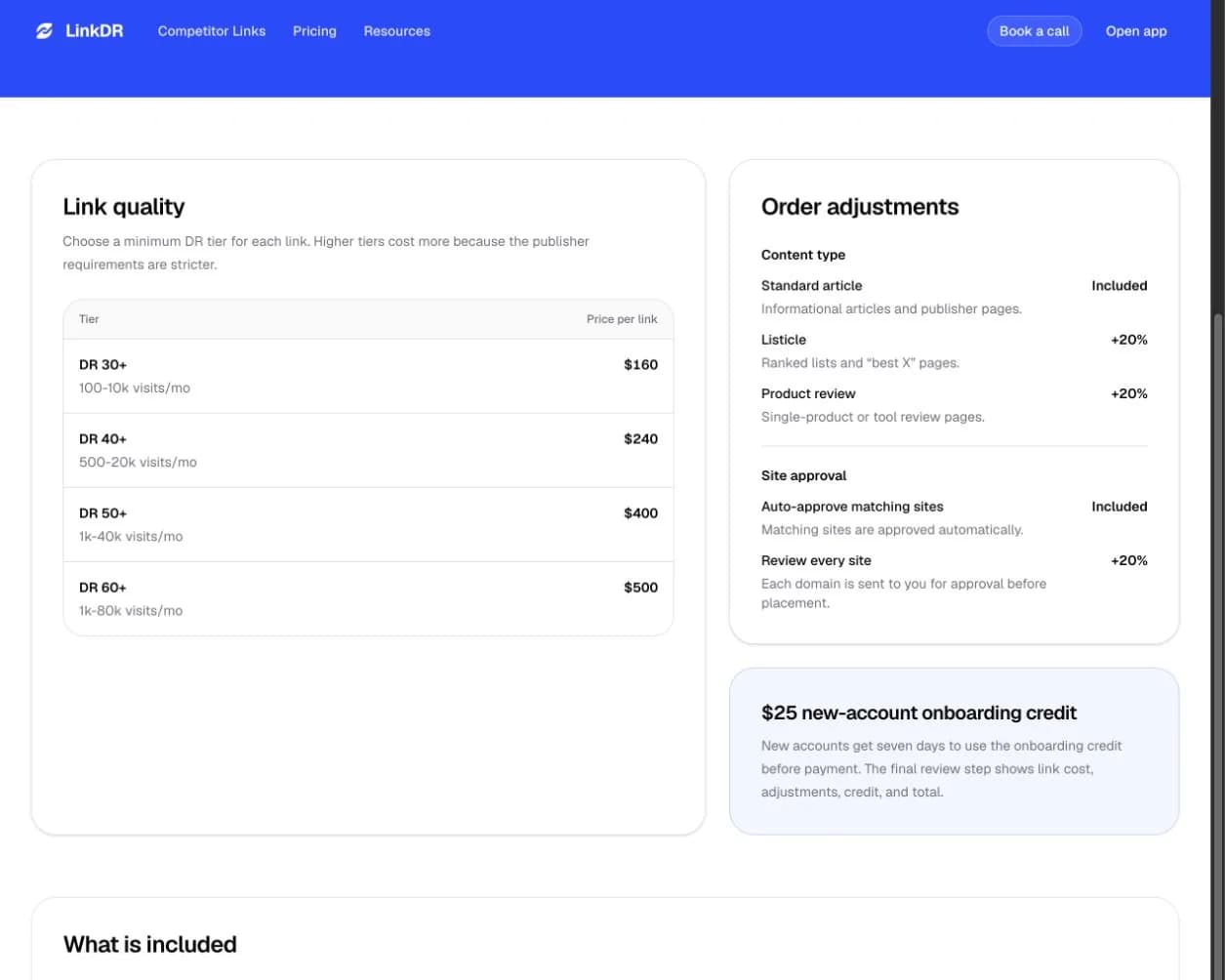
- LinkDR currently lists $160 for DR30+, $240 for DR40+, $400 for DR50+, and $500 for DR60+ placements.
- A listicle, product review, or manual site approval each adds 20% to the order.
- Choose BacklinkGPT if you want to build relationships under your own brand. Choose LinkDR if you want a simpler way to order a defined placement.
Pricing snapshot
LinkDR pricing, without the guesswork
This is the public pricing page we used for the comparison. Here are the numbers worth paying attention to.
What you need to know
- LinkDR charges by the backlink, from $160 for DR30+ to $500 for DR60+.
- A listicle, product review, or manual site approval each adds 20%.
- New accounts get a $25 credit, which the page says expires after seven days.
DR and traffic can help you screen a site. They cannot tell you whether a link will improve rankings, send qualified traffic, fit the topic, or stay live.
See the live page
https://linkdr.com/pricingView pricingBacklinkGPT vs LinkDR at a glance
You are choosing between two ways of building links, not two versions of the same tool.
Which is the better fit?
 BacklinkGPT
AUTONOMOUS AGENT
Own the pipeline
 LinkDR
BACKLINK ORDERS
Buy placements
Primary product
BacklinkGPT
An agent that finds prospects, drafts outreach, handles replies, and tracks linksLinkDR
A service for ordering individual backlink placementsPublished price
BacklinkGPT
$149 / $399 / $999 per monthLinkDR
$160–$500 per backlink before add-onsHow new opportunities appear
BacklinkGPT
The agent searches every night and explains why each prospect is worth pitchingLinkDR
LinkDR matches publishers to the DR and traffic level you selectedWhat you review
BacklinkGPT
Every email or LinkedIn message before it sendsLinkDR
Matching sites only if you add the 20% manual-approval optionWho owns the relationship
BacklinkGPT
Your team — outreach runs through your email and LinkedIn accountsLinkDR
LinkDR runs the publisher and placement processHow you budget
BacklinkGPT
Monthly agent capacityLinkDR
Links ordered and DR levelWorkflow: how teams use it
This is where the biggest day-to-day difference appears—not just in the feature list.
BacklinkGPT workflow
- 1
Connect your domain and senders
The agent reads the site, identifies money pages, and seeds relevant search angles.
- 2
The agent hunts every night
SERP scans, competitor mining, page judgment, and contact discovery keep the queue moving.
- 3
Approve the outreach
You review each draft; approved messages send inside your configured window and pacing.
- 4
Own the replies and outcomes
Replies are triaged and live backlinks remain part of the same relationship history.
LinkDR workflow
- 1
Configure the target
Choose a landing page, anchor, minimum DR tier, and content type.
- 2
Choose approval settings
Auto-approve matching sites or add manual review to the order.
- 3
Review the price
Your DR level and any 20% add-ons determine what you pay.
- 4
LinkDR arranges the placement
LinkDR finds the publisher and handles the content format you selected.
The question that matters most: what are you actually buying?
A higher DR tier is not the same thing as a better backlink. Before approving a LinkDR placement, look at the specific page: is it indexed, does it rank or receive traffic, is the topic genuinely relevant, and will your link sit naturally inside the main content? LinkDR's own backlink checker uses page traffic, domain traffic, dofollow status, in-content placement, and outbound-link count alongside DR. Those checks are more useful than DR on its own.
Also confirm how long the link must remain live and what happens if it is removed, changed to nofollow, or moved to a weaker page. If those terms matter to your purchase, get them in writing.
Who is behind LinkDR?
LinkDR was launched in 2024 by SEO founders Ilias Ismanalijev and Lewis Carhart. The product has moved from its original outreach-software positioning toward ordering individual placements by quality tier. That makes the current pricing page more relevant than older launch coverage or tutorials.
Questions to ask before choosing
Quick answers to the points worth checking before you choose.
Sources
Last reviewed: 2026-07-23
LinkDR pricing
Current DR tiers, add-ons, approval pricing, and onboarding credit.
https://linkdr.com/pricingLinkDR terms
https://linkdr.com/blog/termsLinkDR launch announcement
Launch date and founding-team background.
https://news.marketersmedia.com/linkdr-launches-ai-link-building-tool-for-seo-outreach/89139842


