

At a glance
BacklinkGPT vs Pitchbox
Pitchbox is a mature outreach platform with strong agency operations. BacklinkGPT is different: an AI agent that hunts backlinks for your domain every night — and you approve every send.
- You want an agent, not an ops platform to staff: it scans SERPs nightly, judges every page with a written rationale, finds the right contact, and drafts the pitch.
- You want autonomy with a safety rail: approval is the default on every plan — nothing sends without you — with automatic warm-up ramps and a business-hours send window.
- You want honest capacity pricing: plans sell senders + daily pace; credits (2,000 / 6,000 / 20,000) are a fair-use meter, not tier caps to plan around.
- You want agency-grade role workflow (Inspector, Personalizer, Approval) and heavy process control.
- You want hard plan caps spelled out by tier (emails/month, email accounts, links monitored, workspaces).
- You are okay paying more for a mature, ops-heavy outreach platform (plus separate SEO tool subscriptions for metric integrations).
TL;DR
The short version. Use the sections below if you need details.
- Pitchbox is tier-cap driven (emails/month, accounts, monitored links, workspaces). BacklinkGPT sells capacity — senders + daily agent pace — with credits as a fair-use meter.
- If you need agency role workflow (inspect, personalize, approvals) and multi-workspace operations, Pitchbox often fits better.
- If you want the pipeline moving without staffing an ops process — the agent hunts nightly, you approve every send — BacklinkGPT often fits better.
Pricing snapshot
Pitchbox pricing, without the guesswork
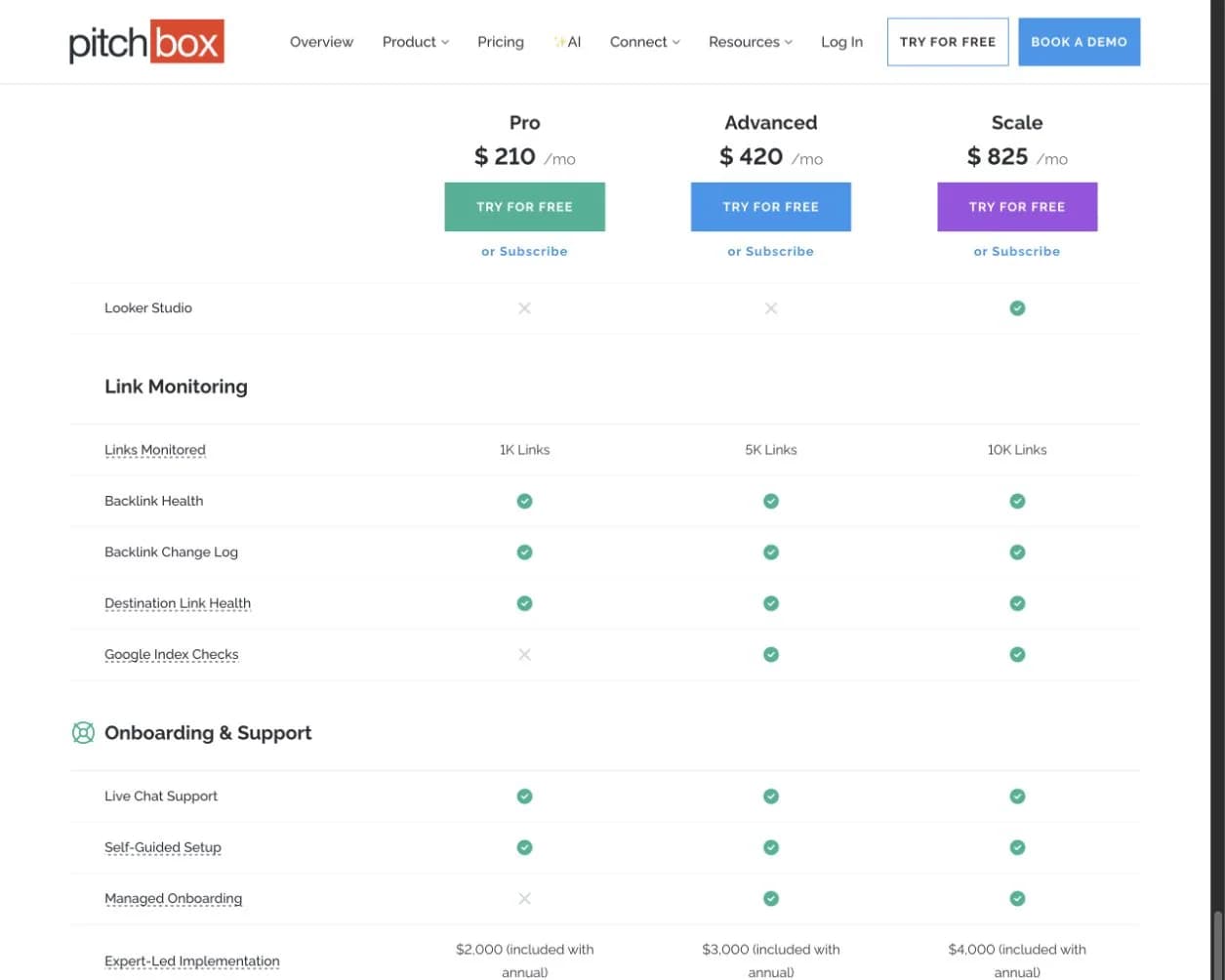
This is the public pricing page we used for the comparison. Here are the numbers worth paying attention to.
What you need to know
- Pitchbox prices a structured outreach platform around users, email accounts, workspaces, and monthly allowances.
- The pricing page shows separate Pro, Scale, and Advanced tiers, with a 30% annual-commitment discount.
- The product remains optimized for teams operating campaigns and approvals, not for an agent working independently overnight.
Published plan limits establish the commercial model. They do not show the onboarding effort, optional services, or negotiated enterprise terms a specific team may receive.
See the live page
https://pitchbox.com/pricing/View pricingWorkflow: how teams use it
This is where the biggest day-to-day difference appears—not just in the feature list.
BacklinkGPT workflow
- 1
Enter your domain
The agent reads your site, picks target pages, seeds keyword angles, and judges its first prospects in minutes.
- 2
It hunts every night
Nightly SERP scans, competitor backlink mining, and contact discovery keep the pipeline stocked — on your timezone, within your plan.
- 3
You approve, it lands
Drafts wait in your review queue; approved sends go out in your send window, replies get triaged, and live links are tracked.
Pitchbox workflow
- 1
Role-based orchestration
Use Inspector/Personalizer roles and approval routing for agency operations.
- 2
Campaign lifecycle in teams
Run per-workspace campaigns with dedicated operational handoffs.
- 3
Tier-cap planning
Forecast against monthly caps for emails, accounts, workspaces, and monitoring.
- 4
Placement execution and follow-up
Prioritize placement progress and operational handoffs across team members.
Pricing and billing semantics
How your cost changes when you add inboxes, volume, and clients.
Which is the better fit?
 BacklinkGPT
SELF-SERVE
Explicit cost drivers
 Pitchbox
AGENCY
Hard caps by tier
Published base pricing
What you can validate publicly without a sales call.
BacklinkGPT
BacklinkGPT: Starter $149/mo, Growth $399/mo, Scale $999/moPitchbox
$210/mo (Pro), $420/mo (Scale), $825/mo (Advanced) when billed annuallyPrimary cost driver
The lever that makes your bill go up as you scale.
BacklinkGPT
Capacity: senders + daily agent pace (credits are fair-use fuel)Pitchbox
Tier upgrades + add-onsIncluded inboxes
How many sender accounts you can connect by default.
BacklinkGPT
1 / 3 / 6 connected senders (by plan)Pitchbox
2 / 6 / 15 (by tier)Send capacity (default safeguards)
A practical “how much can we send” estimate.
BacklinkGPT
≈900 email attempts/month per inbox (30/day in your timezone’s send window; follow-ups included)Pitchbox
Tiered monthly caps (2,000 / 5,000 / 15,000 outreach emails) + 150/day per campaign capOverage model
What happens when you need more.
BacklinkGPT
Credits: $0.03Inbox: $19/month
Pitchbox
Tier upgrade and/or contract add-onNon-obvious extra costs
Costs outside the base subscription.
BacklinkGPT
Mostly just credits + extra inboxesPitchbox
AI personalization cost (~$0.03/opportunity), paid SEO tool subscriptions, and optional implementation/add-onsHard caps that can stop you mid-month
What you must plan around.
BacklinkGPT
Credits and inbox countPitchbox
Emails/month, monitored links, searches, workspaces (tiered)Deep feature comparison
Where the operational differences show up after week 1.
Which is the better fit?
BacklinkGPTBACKLINK-FIRST
Track to links
PitchboxOPS-HEAVY
Roles + approvals
Approval workflow
Inspector -> personalizer -> approval style process.
BacklinkGPT
Default on every plan: nothing sends without your approvalPitchbox
Approval workflow on Scale planWorkspaces / client separation
How you separate clients, teams, and processes.
BacklinkGPT
Organization-based workflowPitchbox
Workspaces by tier (built for agencies)Send safeguard style
How oversending is prevented.
BacklinkGPT
Enforced: 30 email attempts/day per inbox (≈900/month; follow-ups included)Pitchbox
Plan caps + per-campaign daily capsSEO data dependency
Do you need other paid tools to populate metrics?
BacklinkGPT
Standalone: the agent brings prospecting, contacts, and drafting built inPitchbox
Metric integrations often require your own SEO subscriptionsLink monitoring model
How monitoring is packaged.
BacklinkGPT
Backlink-first pipelinePitchbox
Monitored-link caps by tierPricing details that affect the real cost
Compare the limits, add-ons, and scaling rules—not only the starting price.
BacklinkGPT
Model
subscription = capacity (senders + daily agent pace); credits are a fair-use meter
Included
- 2,000 / 6,000 / 20,000 prospect credits (fair-use, by plan)
- 1 / 3 / 6 connected senders included
- 7-day trial — the agent shows its work before you pay
Usage & add-ons
- Extra credits: $0.03 (top-up pack or opt-in overage)
- Extra sender: $19/month
Notes
- One marginal price for credits everywhere — no overage arbitrage, no surprise bills.
- Upgrades buy real throughput: more senders and a faster daily pace, not just bigger numbers.
Pitchbox
Model
agency operations by tier
Included
- Agency-friendly role and workflow structure
- Built-in approval processes in Scale
Usage & add-ons
- Seat upgrades
- Higher tiers and optional add-ons
Notes
- Hard caps are often the main scaling constraint for many teams.
- External SEO subscriptions can still be needed for full metric context.
A practical switching plan
Move one workflow at a time, keep the outreach history you need, and test sender setup before scaling.
Steps
- 1
Map your approval and workspace structure
Document how Inspector, Personalizer, and approvals currently flow before switching.
- 2
Run one pilot workspace
Move one campaign into a pilot environment and validate volume caps and handoffs.
- 3
Reproduce role ownership
Translate approval and review responsibilities into BacklinkGPT ownership.
- 4
Standardize reporting and proof
Set consistent reporting for placed links, follow-up count, and client updates.
Checklist
- Which tier covers your required approval model and workspace scale.
- Whether AI personalization is optional or additive in your expected usage.
- Whether monitored-link caps can be replaced without operational surprises.
The question that matters most: will your team actually operate it?
Pitchbox is powerful because it gives a link-building team detailed control over prospecting, roles, approvals, outreach, and reporting. That same depth creates an adoption cost. The buying decision is less about whether Pitchbox has a feature and more about whether you have the people, process, and campaign volume to use it consistently.
Budget for implementation as well as the subscription. Confirm the annual commitment, data-credit usage, outreach limits, workspace structure, and who will own inspection and personalization each week. Independent reviews are broadly positive and reflect a mature product, while the most common caution is the learning curve that comes with its depth.
Who is behind Pitchbox?
Pitchbox was founded in 2012. Co-founder Alex Gopshtein remains a visible product educator and has worked with customers on link-building and outreach systems for more than a decade. That history matters: Pitchbox is established agency software, not a newly launched autonomous agent.
Questions to ask before choosing
Quick answers to the points worth checking before you choose.
Sources
Last reviewed: 2026-07-23
Pitchbox pricing
https://pitchbox.com/pricing/Pitchbox product
https://pitchbox.com/product/Pitchbox approval workflow
https://help.pitchbox.com/article/116-what-is-approval-workflowPitchbox sending limits (daily)
https://help.pitchbox.com/article/198-how-many-emails-can-i-send-per-dayPitchbox company profile
Founding year and company background.
https://www.linkedin.com/company/pitchboxPitchbox prospecting masterclass
Co-founder background and operator-led prospecting guidance.
https://pitchbox.com/events-webinars/pitchbox-prospecting-masterclass-unlock-prospecting-hacks/Pitchbox reviews on G2
Independent review footprint and buyer feedback.
https://www.g2.com/products/pitchbox/reviews


